Globalisation is a disruptive force. A medicinal product is distributed in several countries or regions and used by patients all over the world. As the nature of the pharma industry has evolved, the need for a more global view of regulatory guidance has developed. However, regulators are confided to assuring the safety, quality and efficacy of products while responding quickly and effective to the exponential pace of medical innovation. For the industry, in the business of drug development every delay carries financial as well as human implications. The emerging trend for regulatory authorities with similar values to engage in collaborative work sharing or reliance approaches can work as catalysts for change, enrich regulatory decision making and ultimately benefit patients.
Collaborative assessments have matured considerably since these programmes launched, and as more experience accumulates, regulatory efficiencies and alignment of applications filed in several jurisdictions continue to improve. Collaboration among regulators is essential to avoid duplication of work, release scarce resources for more critical areas and speed up patients access to new affordable products (WHO).
The key challenge for a pharma company to exercise a collaborative filing process is to ensure the right capacity for a project this complex. This means having a firm overview of the entire process and being well equipped in regards of expertise and resources needed throughout the fast-moving process. If you consider pursuing a collaborative assessment approach for your product, this whitepaper addresses everything you need to know to decide if ACCESS Consortium work-sharing or Project Orbis is the best option for your needs.
Countries in Respective Collaborative Assessment (current as of 2026)
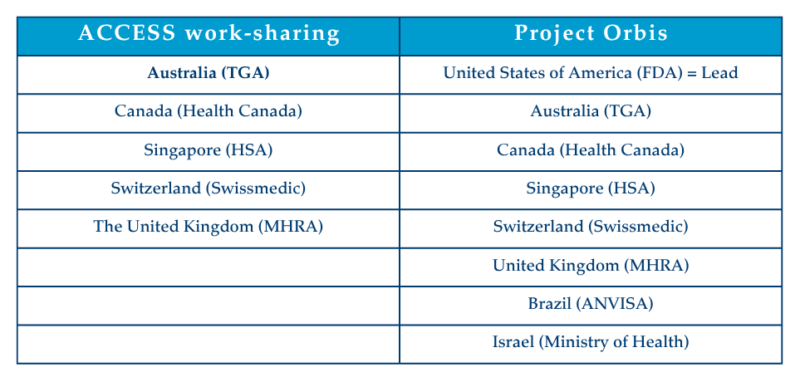
ACCESS work-sharing
The work sharing consortium was formed in 2007 with data sharing and commenced in the current form of dividing the assessment between the participating jurisdictions in 2018. The idea behind this initiative was to promote greater regulatory collaboration and alignment of regulatory requirements, addressing an increasing workload, greater complexity, and limited resources that the agencies experienced. The involved regulatory authorities are like minded, medium sized agencies who all face similar challenges. The participating regulatory authorities allocate responsibilities for review of different CTD modules, to enhance the efficiency of review.
Application pathways considered for the work-sharing are either the standard or priority review pathways. For the applications following the priority review pathway to be eligible for the initiative, it must have priority status in each ACCESS jurisdiction where it is to be filed as part of the initiative, there cannot be a mixture between standard and priority.
The ACCESS consortium has developed 3 authorisation procedures: the New Active Substance Work Sharing Initiative (NASWSI), the Biosimilar Work Sharing Initiative (BSWSI) and the Generic Medicine Work Sharing Initiative (GMWSI). This white paper focuses on the NASWSI only.
Interested applicants are invited to participate by contacting their regional regulatory authority. A domestic application will need to be submitted to each participating regulator simultaneously or as agreed with the regulators. While it is preferable for the application to be identical, modules 2-5 can differ in the applications submitted to each participating regulator. Differences in the application should be outlined and provided to all regulators who may discuss these differences with the applicant to determine if the application is suitable for the work sharing initiative.
Participating regulators negotiate how to allocate the joint assessment workload (i.e., Quality Assessment, Non-Clinical Evaluation and Clinical Evaluation) in between them. Each agency evaluates their assigned module(s) and any country specific aspects. The work-sharing process normally concludes at the end of the evaluation phase as the process enters the national steps. Different laws and frameworks exist in each country which affects regulatory decisions related to product labelling, package material and further on reimbursement issues.
The Access Consortium continues to evolve: the MHRA took over the Consortium's chair for 2026, and the group has endorsed a 2026 action plan centred on a shared digital platform for real-time information exchange and joint assessments, alongside early-stage work exploring a reliance approach for clinical trials.
Collaboration among regulators is essential to avoid duplication of work, release scarce resources for more critical areas and speed up patients access to new affordable
The Process
If you are considering taking part in the work-sharing, you should start by submitting an Expression of Interest (EOI) request form. Here, you select which of the ACCESS regulators you wish to submit your application for joint review to. Initiate communication with the regulators in the countries where you are planning to submit your application early, preferably three to six months before the intended filing date.
Pharma companies may propose, in writing, projects and work items to the agencies for consideration. A work sharing initiative may be considered for a new chemical entity (NCE), new biologic entity (NBE) application and for new indication applications that are filed to two or more of the ACCESS Consortium members.
The application should be submitted to each of the nominated regulators simultaneously or as agreed with the participating regulators. Each regulator will evaluate their assigned modules and will discuss issues and share the outcomes with the other regulators in the joint review via scheduled teleconferences throughout the evaluation period.
How the common and country specific questions are provided from the regulators depends on whether the joint review is under standard or priority review. Under priority review, the questions will be 'rolling questions' throughout the evaluation period. On the other hand, under the standard pathway, regulator questions are often consolidated and sent to all local applicants simultaneously. This process is agreed upon through the application pathway and ACCESS-sponsor negotiations.
The timeframe in which a response is required depends on the requirements from the agencies lead evaluator of that module and the selected procedure (standard or priority). The dossier must be updated in all jurisdictions to ensure that the application is complete. Subsequently, the responses are assessed by the lead evaluating agency assigned to a module and peer-reviewed by the other participating agencies. Although sharing the workload, all involved agencies retain their sovereignty to take independent decisions according to their respective high standards for quality, efficacy and safety standards and involve their external expert committees.
Project Orbis
In 2019, the FDA Oncology Center of Excellence (OCE) launched Project Orbis, a framework for near-concurrent submission and review of high-impact oncology products across multiple countries. This approach may allow patients with cancer to receive earlier access to products across countries. Besides the obvious - to accelerate approval and availability of new, innovative oncology therapies to patients - Project Orbis also has a pragmatic take. It is also about having a uniform standard of care that is widely accepted throughout the world since this new standard of care becomes the new control arm for subsequent trials.
Orbis engages a similar set of national regulatory authorities to ACCESS, however it does not involve work sharing. Three major factors allow national decisions to be expedited through Project Orbis: the initial FDA review, access to the same data and the opportunity to interact directly with the review team. Since 2023, the European Medicines Agency has participated in Project Orbis as an observer, alongside continued interest from other regulators in the model.
New marketing authorisation applications (MAAs) with new active chemical or biological substances and new indication applications for oncology medicinal products are eligible for Project Orbis. The selection of applications is coordinated by FDA, and either the FDA or the U.S. sponsor can propose an application once notable results are available from the registrational clinical trials. As a sponsor, you must include the global submission timing and plan for the country-specific submissions. FDA sends the proposal to the regulatory agencies to confirm interest and availability for participation.
The Process
The submission must include a minimum of two regulatory health authorities, including FDA. FDA confirms with the local regulatory authorities and designated participating jurisdictions, called Project Orbis Partners (POPs), for the application. There are several types of Project Orbis submissions which are dependent on the submission gap between the FDA and POPs.
- Type A (Regular Orbis): Submissions are submitted in parallel (within 30 days) to FDA and POPs and allow for maximal collaboration during the review phase with the possibility of sharing of review documents, exchanging requests for information, observing and participating in multi-agency discussions and obtaining concurrent regulatory action with FDA.
- Type B (Modified Orbis): For applications with a >30-day delay in submission compared to FDA or where an FDA regulatory action was taken >3 months ago, a nearly parallel review and/or regulatory action can be achieved, largely depending on the size of the submission gap.
- Type C (Written Report Only Orbis): FDA has already taken regulatory action, allowing FDA to share their completed review documents with POP for evaluation. Leveraging of the FDA Assessment Aid (AAid) by POPs can result in faster approval times in those jurisdictions.
During its first year, 70% of the Project Orbis applications were of Type A. For Type A and Type B Orbis applications, it is generally expected that the sponsor submits a 'global dossier', i.e., the same data set for Modules 2-5 (noting country-specific aspects) as submitted to the FDA and other participating agencies. Any differences between the submissions should be clearly indicated in the application cover letter and discussed with local authorities in advance. By mid-2025, the programme had grown substantially, encompassing over 630 regulatory submissions across around 80 distinct oncology products since its 2019 launch.
Project Orbis applications are generally expected to meet the criteria for FDA priority review which include that the drug is intended to treat a serious condition and if approved, would provide a significant improvement in safety or effectiveness. Each marketing application should also conform to the respective domestic submission requirements. Deciding which jurisdiction(s) to pursue in addition to the FDA is central. The selection can be based on an assessment of the accelerated approval opportunity-risk trade-offs per market as well as the internal capacity for the number of jurisdictions to approach.
The applicant must ensure that all responses to information requests submitted to the individual POPs are also provided to all other participating project Orbis agencies, minimising duplication, and keeping all stakeholders up to date.
An additional requirement for Type A or B Orbis submissions is the use of a multidisciplinary review document, the FDA Assessment Aid (AAid), which serves as the primary review document for FDA and a core document for the joint discussions. Therefore, instead of other countries rewriting the report, they can cross references to the FDA review.
Each regulatory authority involved in a Project Orbis application remains fully independent with regulatory decision-making to adhere to country-specific laws, regulations, ordinances, and policies. This may result in differences in the approval or rejection of marketing authorization, the application.
Key differences
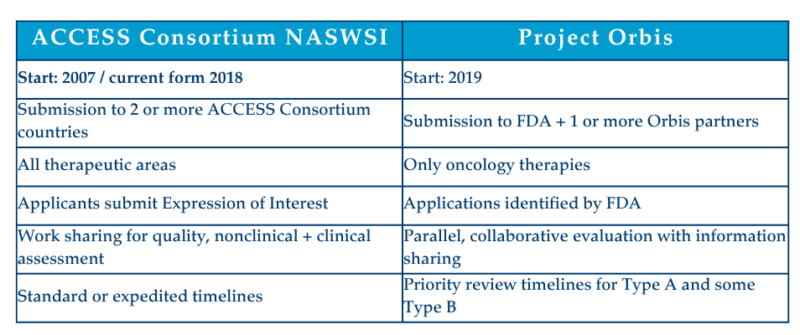
While some of the features are similar, the major difference between the initiatives is that the ACCESS Consortium's NASWSI is a true work-sharing procedure where the review workload is split up between agencies, whereas the concept of Project Orbis is a parallel or semi-parallel review between FDA and POPs (Type A and Type B) or leverage of the AAid by POPs (Type C) in cases where FDA has already taken regulatory action.
Table 1: Key Differences between ACCESS Consortium NASWSI and Project Orbis
Challenges and Benefits
Collaboration among international regulators may allow earlier access to products in more countries without delays in regulatory submissions. Even though the ACCESS Consortium and Project Orbis have two distinct methods of operation, the commitment and workload are very similar.
Challenges:
- The key challenge for a pharma company to manoeuvre parallel filings from start to finish is to have the capacity and capability for a project of this magnitude.
- The unique requirements of individual participating countries must be taken into consideration.
- Shorter timelines and multiple agency interactions need to be organized in parallel.
- High-level project management is a necessity to coordinate actions on every level.
Benefits:
- Less duplication of efforts.
- Consolidated questions across the regulatory agencies which generally means a reduced number of questions for the applicant.
- Global access to multiple markets through a simultaneous evaluation process.
- Shortened time to regulatory approval.
Knowledge, network, and manpower
There are critical factors that drive decisions on national approval and access to medicines. Such factors include varying public health needs and priorities and how the product is expected to be used relative to any existing therapies. These factors can drive divergent regulatory authority approval decisions and aligned regulatory submissions will not automatically result in aligned approvals or patient access.
Question you need to address in advance to prepare if a collaborative assessment pathway becomes potentially relevant for your product is - what are our internal resources and what kind of support would we need? Having a solid overview of the entire process and being well equipped with regard to expertise and resources is imperative to successfully navigate through the fast-moving process. Early interactions with regulators are crucial to determine expectations and to prepare for a coordinated filing under tight timelines. Thoroughly assess which participating countries you are targeting and for how many you have the capacity to manoeuvre through the procedure. For each jurisdiction there are national requirements and procedural aspects that demand local regulatory knowledge and established agency contacts that can be advanced through a local regulatory partner. It is also worthwhile, if not to say crucial, to find a contractor who has a well-established network as well as experience and can turn this around quickly and efficiently to a high standard. To keep it all together you will need top tier overarching project management. Dealing with the different health authorities simultaneously requires split vision, fast turnaround, and a solid strategy throughout the process.
Although a nearly parallel, independent regulatory review or work-sharing by several different regulatory agencies may sound very resource intensive, the collaborative approach can reduce the regulatory resources for both the participating agencies and applicants by eliminating duplicate questions and other redundancies. The utilisation of a common dossier, shared and consolidated evaluation questions and responses has proven to shorten regulatory evaluation timelines significantly. Having the opportunity to place your medicinal product on multiple markets in one calculated attempt saves valuable time for the patients in these markets.
Conclusion
Both initiatives have matured well beyond their early years, but the regulatory agencies involved continue to learn from differences in each other's frameworks, adapting and streamlining their processes to fully benefit from the collaborative approach. Overall, it is essential to have the necessary manpower, regulatory knowledge and project management capabilities to fulfil the requirements of a global multi-jurisdictional parallel assessment across various time zones. Almost always successful filing of a submission of this magnitude leads to significantly faster time to approval when compared to standard procedures. This in turn allows for developers to commercialize sooner and for patients to gain access to novel life-saving therapies early on.
If you're weighing ACCESS Consortium work-sharing against Project Orbis for an upcoming filing, our team has run both processes across multiple jurisdictions and can talk through which fits your product and timeline. Let’s talk!
References
- FDA website, Project Orbis https://www.fda.gov/about-fda/oncology-center-excellence/project-orbis
- FDA, Project Orbis https://www.fda.gov/about-fda/oncology-center-excellence/project-orbis
- Australian Government, Department of Health and Aged Care https://www.tga.gov.au/international-activities/australia-canada-singapore-switzerland-united-kingdom-access-consortium