Target product Profile (TPP) Guide
The Target Product Profile is key when building a portfolio strategy, providing aid throughout major decisions such as optimization of drug candidates, design of clinical studies, and constructive communication with regulatory authorities. Used properly, the Target Product Profile (TPP) is an indispensable tool to demonstrate quality, highlight development priorities and to tackle challenges on the journey from pre-clinical development to approval.
What is a TPP?
The TPP is not only a detailed regulatory document but a guide to the future development process. It also describes the characteristics and features of a biotechnology product. The aim is to guide the development and implementation of the product’s regulatory strategy early in the process and to foster the dialog on clinical development or manufacturing. As a result of structured and timely planning, TPP-related products likely require less time for review by the authorities.
The contents of a TPP vary from compound to compound and from team to team, but each profile generally includes: an indication for use, intended patient population, target therapeutic benefit, and safety and efficacy characteristics. In addition, it also consists special manufacturing requirements, such as the formulation, dosage, and route of administration.
The TPP is a rather brief document. It can be organized according to the key sections of the drug labelling, capturing a summary of the drug development activities and labelling concepts.
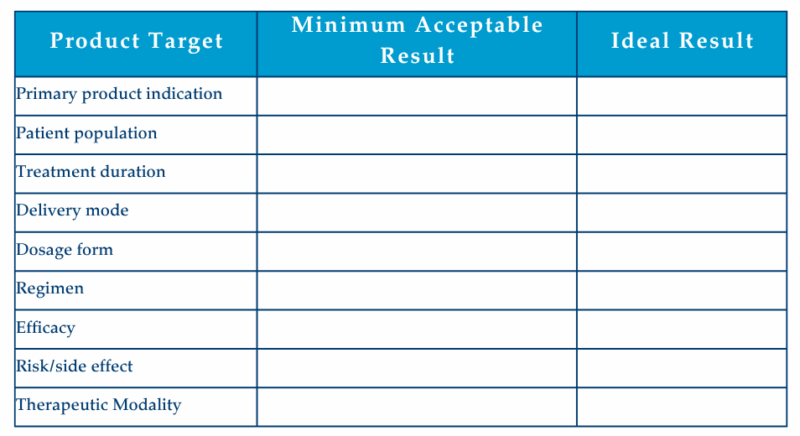
When mapping out the TPP you list different product targets together with the minimum acceptable result as well as the ideal results for each target.
Here is a basic example of how a product target list can be presented:
The FDA has a formal guidance document on how to develop the TPP and encourages sponsors to use it since it provides the Regulatory Agency with the technical details of the proposed product to better frame the questions being asked during the upcoming interactions. In this guidance, the FDA defines a TPP as
“A format for a summary of a drug development program described in terms of labeling concepts.”
Why is an early TPP important?
Many developers find it useful to have a TPP during the pre-clinical development because the plan is a useful tool to provide a future perspective and focus: it helps delineate the required and desired features, the main milestones, and the metrics. The TPP provides a framework to ensure that the preclinical development program supports the intended clinical trial design and therapeutic use. Biotech companies should look at the TPP as a provider of several key benefits during pre-clinical development:
- It lines up the efforts and resources of all stakeholders: the development team, regulatory agencies, and investors to one common, long-term goal.
- A TPP is an asset for the identification of the characteristics of the product, such as the patient population, therapeutic benefit, indications for use, and safety and efficacy characteristics providing an outline for the future development and the design of the clinical development program.
- It informs the regulatory strategy including the selection of appropriate preclinical and clinical studies.
- When the TPP is developed early, it prevents unnecessary costs and delays.
- A TPP helps to facilitate better decision-making by providing a clear picture of the product’s intended characteristics and benefits.
The TPP should be a tailored document from early in the preclinical development according to the product specifics, timelines, strategic goals and the target audience.
Maximising your TPP
How early is early? The TPP, if used properly, can play an essential role when building your development strategy, moving forward effectively. As soon as the company has nominated a candidate drug based on certain criteria; acceptable pharmacokinetics, demonstrated in vivo efficacy/activity, acceptable safety margins, feasibility of GMP manufacture, acceptable drug interaction profile and well-developed clinical endpoints, the work should commence.
According to our experts, the TPP keeps the drug developer focused on the ‘end game’ driving the early development with the final product in mind. The document needs to be reviewed quarterly or at a minimum annually and modified in response to changes in the external environment and emerging data. It is advisable to maintain different versions of a TPP depending on the intended audience (e.g., external or internal), which should be aligned including the same target labelling document.
Conclusion
The TPP formulates the problem and formalizes what you have and what your strategy therefore should be. This dynamic document is your go-to support, when facing “go/no go” decisions at critical development hot spots throughout the lengthy development process. The TPP can also assist in the achievement of constructive feedback and understanding from the Agency, which is critical for successful drug development.
When new data is accumulated, the TPP should be updated to continue to support the best way forward. Later in the development, the document evolves by including all the updates from the interactions with the agencies, input from commercial or marketing assessments, and the clinical changes in the drug product.
SSI's team of non-clinical development experts can support the creating of a strong Target Product Profile providing clarity around your intent, the potential of your product, and a path to overcome the challenges that you will be facing in your program.